Escrow Savings Accounts
Helping You Save for Taxes and Insurance
At People Driven Credit Union (PDCU), we understand that managing annual expenses like property taxes and insurance can be challenging. That’s why we are proud to introduce the Escrow Savings Account — a smart and structured way to save for these important obligations while earning interest.
How It Works
- Open a Dedicated Savings Account: Set aside funds for taxes, insurance payments, or other savings goals.
- Member-Controlled Deposits: Make deposits at any time. Automatic deductions are not available.
- Limited Withdrawals: To encourage saving, this account only allows up to six withdrawals per year.
Account Details
- Interest Rate: Earn interest at 0.50% APY². Rates are subject to change and will be disclosed in compliance with Truth in Savings (TISA) regulations.
- Fees: There may be monthly maintenance fees or withdrawal fees. Please refer to our fee schedule for specific details.
- NCUA Insurance: Your funds are insured up to $250,000 per depositor, for each account ownership category.
More About PDCU Membership...
-
Membership Eligibility
Check People Driven Credit Union's membership eligibility requirements.
-
Member Services
View all the perks and benefits of becoming a member of People Driven Credit Union.
-
Membership Rewards
PDCU rewards members for all types of activity.
-
Visit Us
PDCU is a full-service credit union with branches and ATMs that are easily accessible around Southeast Michigan.
... Love that when you call, you get someone right here in Michigan.
James R.
Escrow Savings Account Rates
|
Minimum Deposit |
Dividend/Interest Rate |
APY² |
| $100 | 0.499% | 0.50% |
|
Rates Effective as of: |
||
Note: $1 minimum to open an Escrow Savings Account. $100 minimum to Earn Dividends.
Frequently Asked Questions
Domestic wire transfers are usually processed the same business day if the request is submitted before the daily cutoff. In many cases, funds are available to the recipient within hours.
Actual timing can vary based on when the transfer is requested and the receiving financial institution, so contact People Driven Credit Union if you need help with a time-sensitive wire.
People Driven Credit Union currently charges $30 for an outgoing domestic wire transfer and $50 for an outgoing international wire transfer. Because fees can change, we recommend reviewing our current fee schedule or contacting us directly if you have questions about wire transfer costs.
An ACH transfer is commonly used for everyday electronic transactions such as direct deposit, external account links, and automatic payments. A wire transfer is typically used when money needs to move more quickly, especially for larger or more time-sensitive payments.
ACH transfers and wire transfers are not the same, and they may use different instructions. If you are setting up a wire transfer, make sure you use People Driven Credit Union’s specific wire instructions instead of relying only on the standard routing number.
To send a wire transfer from your People Driven Credit Union account, call us at 248-263-4100 or visit a branch for assistance. You will need to provide the recipient’s full name, address, account number, and the receiving financial institution’s routing information.
Wire transfers are typically used for large or time-sensitive payments. Because wires are processed using specific instructions and generally cannot be reversed once completed, it is important to verify all details carefully before submitting your request.
Yes. You can use People Driven Credit Union’s routing number, 272484988, for direct deposit. You will also need your personal account number so your deposit is sent to the correct account.
When setting up direct deposit, make sure you provide both the correct routing number and the correct account number. If you are a former Community Alliance Credit Union member, be sure to use People Driven Credit Union’s routing number for any new direct deposit instructions.
A routing number identifies the financial institution, while an account number identifies your specific account at that institution. You may need both numbers to set up direct deposit, automatic payments, ACH transfers, or external account links.
People Driven Credit Union’s routing number is 272484988. Your account number is unique to you, so be sure to use the correct account number for the specific checking or savings account you want to use.
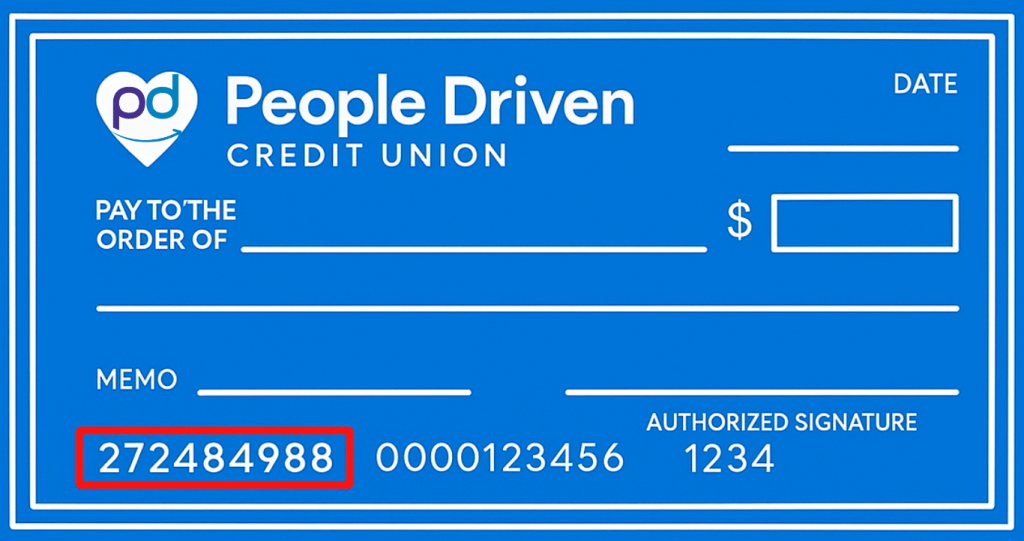 Where to find a Routing Number on a check
Set up your Checking Account with People Driven Credit Union nnline in just minutes or visit any of our branches in Livonia, Southfield, Warren, Ypsilanti, or Romeo.
Pro Tip from PDCU: Link your Checking Account to your Savings Account for automatic overdraft protection and set up recurring transfers (even $25/paycheck for Save to Win) to watch your balance grow. Members who use both accounts save more and avoid fees.
A 16-month CD (Certificate of Deposit) is a type of savings account offered by banks and credit unions. Here are the key characteristics:
- Fixed Term: It has a maturity period of nine months, during which the deposited money is locked in.
- Interest Rate: Typically offers a fixed interest rate generally higher than regular savings accounts.
- Minimum Deposit: Often requires a minimum deposit amount to open the account.
- Early Withdrawal Penalty: If you withdraw the funds before the 16-month term ends, you usually incur a penalty, a portion of the interest earned, or a specified fee.
- FDIC Insured: In the United States, CDs from credit unions are usually insured by the National Credit Union Administration (NCUA) up to $250,000 per depositor per credit union.
A 16-month CD can be a good option if you have a specific short-term savings goal and want to earn a higher interest rate without taking on much risk.
A 16-month CD works as follows:
- Opening the CD: You deposit a lump sum of money into the CD account. The amount often needs to meet the bank or credit union's minimum deposit requirement.
- Fixed Term: The money is committed to the CD for a fixed term of nine months. During this period, you cannot add to or withdraw from the principal amount without incurring penalties.
- Interest Rate: The bank or credit union pays you a fixed interest rate on the deposited amount for the entire term. This rate is usually higher than that of a regular savings account because the bank can use your money for a predictable period.
- Interest Accumulation: Interest is typically compounded and credited to your account at regular intervals, such as monthly or quarterly.
- Maturity: At the end of the 16-month term, the CD matures. You then have a few options:
- Withdraw the funds: You can take out your initial deposit plus the interest earned.
- Renew the CD: You can roll over the funds into a new CD, either for the same term or a different one, possibly at a new interest rate.
- Transfer the funds: You can transfer the money to another account.
- Early Withdrawal Penalty: If you need to access the money before the 16-month term ends, you will likely face an early withdrawal penalty. This penalty varies by institution but generally involves forfeiting a portion of the interest earned.
- FDIC/NCUA Insurance: If the CD is held at a bank, it is insured by the FDIC (Federal Deposit Insurance Corporation) up to $250,000 per depositor per bank. If held at a credit union, it is insured by the NCUA (National Credit Union Administration) with the same coverage limits.
A 16-month CD can be a suitable option for short-term savings goals, offering a balance between earning a higher interest rate and having your money tied up for a relatively short period.
Yes, your money is safe in a 16-month CD. At People Driven Credit Union, our CDs are insured by the NCUA (National Credit Union Administration) up to $250,000 per depositor.
Withdrawing money from a 16-month CD before the term ends typically incurs an early withdrawal penalty. At People Driven Credit Union, the Early Withdrawl Penalty is a Loss of 90 days of interest for withdrawing funds early.
APY stands for Annual Percentage Yield. It is a measure of the total amount of interest earned on an account based on the interest rate and the frequency of compounding over a year. APY is a useful metric for comparing the annual earnings on different savings products, such as savings accounts, CDs, and money market accounts, because it standardizes the effect of compounding.
Key Points About APY
- Includes Compounding: APY accounts for how often interest is compounded (e.g., daily, monthly, quarterly), which can significantly affect the total interest earned over time.
- Comparison Tool: APY provides a standard way to compare the annual interest earnings of different savings products, regardless of how frequently interest is compounded.
- Formula: The formula for calculating APY is:
APY = (1 + r/n)^n - 1
where r is the nominal interest rate (expressed as a decimal), and n is the number of compounding periods per year. - Higher APY: A higher APY indicates that you will earn more interest on your money over a year, assuming the same principal amount.
Example
For example, if a savings account offers an interest rate of 5% compounded monthly, the APY would be higher than 5% due to the effect of monthly compounding. This makes APY a useful metric for comparing the real return on different financial products.
Think of a CD (Certificate of Deposit) like a special piggy bank at People Driven Credit Union. You put your money in our big piggy bank, promise to leave it there for one year, and when the year is up, we give you all your money back plus extra money called interest. The longer you let us keep it safe, the more it can grow. It’s a fun way for kids to learn patience, saving, and how money can earn more money over time.
- Transfers occur only if sufficient funds are available in the linked account.
- A per-transfer fee may apply. View our current fee schedule.
- Funds are transferred in the exact amount needed to cover the transaction, subject to available balance and transfer limits.
- Checks
- ACH transactions (such as electronic bill payments)
- Recurring debit card payments
Important Disclosures:
- Eligibility is based on account history and credit union discretion. Not all accounts qualify.
- A per-item overdraft fee will apply to each transaction we pay using Courtesy Pay. View our current fee schedule.
- There is no guarantee that we will authorize and pay any transaction, even if your account is eligible for Courtesy Pay.
Overdraft Options
Life happens, and sometimes your balance doesn’t quite cover a transaction. At People Driven Credit Union, we offer several ways to help you manage those moments:1. Overdraft Protection Transfer
Link your Basic Checking Account to a PDCU savings account. If your balance runs low, funds will automatically transfer (if available) to cover your transaction. A small transfer fee may apply; please refer to the Fee Schedule for details.2. Courtesy Pay
With Courtesy Pay, we may authorize and pay overdrafts on your account at our discretion, up to a preset limit, for checks, ACH payments, and recurring debit transactions. This can help avoid declined payments or returned items.- Available to eligible accounts in good standing
- Applies to checks, ACH, and recurring payments (opt-in required for everyday debit card use)
- A per-item fee applies for each overdraft covered
3. No Overdraft Service
You may also choose to opt out of all overdraft services. Transactions that exceed your balance will be declined, and no overdraft fee will apply. Do you have questions about your overdraft protection options, or would you like to set your preferences? Contact our Member Services team — we’re here to help you choose the option that’s right for you.- Traditional IRA: Contributions may be tax-deductible, and earnings grow tax-deferred until withdrawal.
- Roth IRA: Contributions are made with after-tax dollars, and earnings can be withdrawn tax-free in retirement.
- Educational IRA: Earnings grow tax-free if used for qualifying educational expenses.
Educational IRA vs. 529
An Educational IRA, known as a Coverdell Education Savings Account (ESA), and a 529 Plan are both tax-advantaged savings options for educational expenses, but they differ in several important ways:1. Contribution Limits
- Coverdell ESA: Annual contribution is capped at $2,000 per beneficiary.
- 529 Plan: Contribution limits are generally much higher, often exceeding $300,000, depending on the plan and state.
2. Use of Funds
- Coverdell ESA: Funds can be used for both K-12 education and college expenses, covering tuition, books, supplies, and even certain tutoring services.
- 529 Plan: Primarily designed for college expenses, but recent tax law changes allow up to $10,000 per year to be used for K-12 tuition.
3. Income Limitations
- Coverdell ESA: There are income restrictions for contributors. Individuals earning more than $110,000 (or couples earning more than $220,000) may not contribute.
- 529 Plan: No income restrictions apply to contributions, making it more accessible to a broader range of contributors.
4. Control and Investment Options
- Coverdell ESA: Offers more flexibility in investment choices, allowing account holders to choose from various stocks, bonds, or mutual funds.
- 529 Plan: Investment options are generally limited to a selection provided by the state or plan administrator, often with age-based portfolios that adjust risk over time.
5. Ownership and Control of Funds
- Coverdell ESA: If funds aren't used for education, the account must be transferred to the child when they turn 30.
- 529 Plan: The account owner retains control over the funds indefinitely, and there’s no age limit for the beneficiary to use the funds.
6. Tax Benefits
- Both accounts grow tax-free, and qualified withdrawals for education expenses are also tax-free.
In summary, the Coverdell ESA offers flexibility in investment options and covers a broader range of K-12 expenses. At the same time, the 529 Plan has higher contribution limits and no income restrictions and is more commonly used for college savings.
Withdrawing money from a 9-month CD before the term ends typically incurs an early withdrawal penalty. At People Driven Credit Union, the Early Withdrawl Penalty is a Loss of 90 days of interest for withdrawing funds early.
Yes, your money is safe in a 9-month CD. At People Driven Credit Union, our CDs are insured by the NCUA (National Credit Union Administration) up to $250,000 per depositor.
Interest Rate or Dividend Rate: the Base Number
Interest Rate
The interest rate is the basic percentage a bank or credit union uses to calculate how much you’ll pay on a loan or earn on a deposit, before considering how often interest is added (compounded). Let’s say you open a credit union savings account with an interest rate of 3.00%. That’s the base rate your money earns before compounding is applied.Dividend Rate
At a credit union, the term "dividend rate" is often used instead of "interest rate" for deposit accounts. As a member-owner, you’re technically receiving a share of the credit union’s earnings—similar to a dividend from a company. Functionally, though, the dividend rate works the same way as an interest rate on a bank account.Annual Percentage: the Full Picture of Earnings or Costs
Annual Percentage Yield (APY)
APY shows how much you earn in a year on deposits, including the effects of compounding. Compounding is the process of earning interest on your interest (for deposits) or being charged interest on interest (for loans). If your account compounds interest daily or monthly, you’ll earn a bit more than the base rate, because you start earning interest on the interest that’s already been added. That extra boost from compounding is why the APY is slightly higher than the interest/dividend rate.Compounding Interest: Dividend Rate vs APY
APY provides a clearer picture of the actual annual earnings from savings accounts, money markets, and certificates because it includes compounding. For loans, APR is the more accurate number for comparing costs between offers, because it reflects compounding as well as fees.- Interest Rate/Dividend Rate: If a savings account offers a 5% interest rate compounded monthly, the nominal rate is 5%. This is the base number for how much your balance will grow before compounding.
- APY: When considering the monthly compounding, the same account will have an APY slightly higher than 5% because the interest earned each month also earns interest in subsequent months.
Comparing Financial Offers Using APY
If you only look at the interest or dividend rate, you might think two products are equal—but differences in compounding or fees can make one clearly better for your wallet. A savings account with a slightly lower rate but daily compounding could earn you more than one with a higher rate but annual compounding.Interest Rate vs APY Example
Always use APY when comparing savings products from different institutions. Knowing the difference between the base rate and APY helps you see the full picture, allowing you to make confident choices—whether you’re saving for a big purchase or making long-term investments. Let’s compare two savings accounts:| Account | Dividend/ Interest Rate | Compounding |
APY |
|
A |
3.00% | Annual | 3.00% |
| B | 3.00% | Monthly |
3.04% |
Let Us Help You With the Next Big Stage of Your Life
At People Driven Credit Union, we’re dedicated to helping you achieve your financial goals. As a member-owned financial institution, we’re literally invested in your future—and stand behind our commitment to transparency, security, and service excellence. Become a member and open an account today!1. How often are dividends compounded?
Dividends on savings, money market accounts, and certificates are typically compounded and credited monthly unless otherwise stated in the account disclosure. Compounding helps your balance grow by earning dividends on previously earned dividends.
2. Why is the APY higher than the dividend rate on a certificate?
The dividend rate is the base rate used to calculate earnings. APY shows what you actually earn over a year, including compounding. Because dividends are compounded, the APY is slightly higher than the dividend rate.
3. What is the difference between APY and APR?
APY applies to deposit accounts and shows how much you earn in a year. APR applies to loans and shows the total yearly cost of borrowing, including certain fees. Use APY when comparing savings products and APR when comparing loans.
4. Does compounding frequency really make a difference?
Yes. The more often dividends are compounded, the sooner you begin earning dividends on previously earned dividends. Over time, even small differences can increase your total earnings.
5. When comparing accounts, should I look at the dividend rate or APY?
APY is the better number to compare. It reflects the total amount you can expect to earn over a year, including compounding, giving you a clearer picture of your true return.
A 9-month CD works as follows:
- Opening the CD: You deposit a lump sum of money into the CD account. The amount often needs to meet the bank or credit union's minimum deposit requirement.
- Fixed Term: The money is committed to the CD for a fixed term of nine months. During this period, you cannot add to or withdraw from the principal amount without incurring penalties.
- Interest Rate: The bank or credit union pays you a fixed interest rate on the deposited amount for the entire term. This rate is usually higher than that of a regular savings account because the bank can use your money for a predictable period.
- Interest Accumulation: Interest is typically compounded and credited to your account at regular intervals, such as monthly or quarterly.
- Maturity: At the end of the 9-month term, the CD matures. You then have a few options:
- Withdraw the funds: You can take out your initial deposit plus the interest earned.
- Renew the CD: You can roll over the funds into a new CD, either for the same term or a different one, possibly at a new interest rate.
- Transfer the funds: You can transfer the money to another account.
- Early Withdrawal Penalty: If you need to access the money before the 9-month term ends, you will likely face an early withdrawal penalty. This penalty varies by institution but generally involves forfeiting a portion of the interest earned.
- FDIC/NCUA Insurance: If the CD is held at a bank, it is insured by the FDIC (Federal Deposit Insurance Corporation) up to $250,000 per depositor per bank. If held at a credit union, it is insured by the NCUA (National Credit Union Administration) with the same coverage limits.
A 9-month CD can be a suitable option for short-term savings goals, offering a balance between earning a higher interest rate and having your money tied up for a relatively short period.
A 9-month CD (Certificate of Deposit) is a type of savings account offered by banks and credit unions. Here are the key characteristics:
- Fixed Term: It has a maturity period of nine months, during which the deposited money is locked in.
- Interest Rate: Typically offers a fixed interest rate generally higher than regular savings accounts.
- Minimum Deposit: Often requires a minimum deposit amount to open the account.
- Early Withdrawal Penalty: If you withdraw the funds before the 9-month term ends, you usually incur a penalty, a portion of the interest earned, or a specified fee.
- FDIC Insured: In the United States, CDs from credit unions are usually insured by the National Credit Union Administration (NCUA) up to $250,000 per depositor per credit union.
A 9-month CD can be a good option if you have a specific short-term savings goal and want to earn a higher interest rate without taking on much risk.
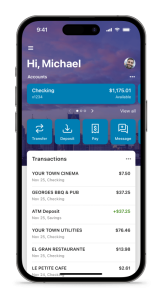
- Set the Stage: Place your check against a dark background to ensure all details are captured clearly due to the contrast.
- Sign and Specify: Endorse the back of the check and write “For Mobile Deposit Only to PDCU” along with your clear signature and account number to streamline processing.
- Open the MyPDCU App: Log in and select "Deposits."
- Enter the Check Details: Enter the check amount and select the account where you want to deposit it.
- Capture the Check Images: Place the front of the check within the phone's frame and tap the screen to capture an image. Repeat for the back of the check.
- Verify the Deposit: Check your transaction history in the app to ensure the deposit was successful.
- Secure Disposal: After confirming the deposit, cut up the check to secure your personal information. Dispose of the pieces separately.
An Educational IRA Certificate, commonly known as a Coverdell Education Savings Account (ESA) Certificate, is a savings product designed to help families save for educational expenses. This type of account combines the benefits of a Certificate of Deposit (CD) with the tax advantages of a Coverdell ESA. Here’s a detailed explanation of its key aspects:
Key Features:
- Tax Advantages: Contributions grow tax-deferred, and withdrawals are tax-free when used for qualified educational expenses.
- Fixed Interest Rate: Like a traditional CD, an Educational IRA Certificate offers a fixed interest rate, providing a predictable return on your investment over a specified term.
- Term Options: These certificates typically come with various term lengths, allowing you to choose one that matches your timeline for the funds needed for educational expenses.
- Contribution Limits: The annual contribution limit for a Coverdell ESA is $2,000 per beneficiary. Contributions must be made with after-tax dollars, but the earnings grow tax-deferred.
- Age Limits: Contributions can be made until the beneficiary reaches age 18. The account must be used for educational expenses by the time the beneficiary reaches age 30.
- Qualified Expenses: Funds can be used for a wide range of educational expenses, including tuition, fees, books, supplies, equipment, and sometimes, room and board for students enrolled at least half-time.
- Transferability: If the designated beneficiary does not need the funds, the account can be transferred to another eligible family member without penalty.
Benefits of an Educational IRA Certificate:
- Tax-Free Withdrawals: When used for qualified educational expenses, withdrawals are tax-free, providing significant savings.
- Predictable Returns: Fixed interest rates offer stability and predictability for your savings.
- Wide Range of Uses: Funds can be used for various educational expenses, covering primary, secondary, and higher education.
Considerations:
- Contribution Limits: The annual contribution limit is relatively low, which might not cover all educational expenses but can significantly help.
- Age Restrictions: Contributions must stop when the beneficiary turns 18. Funds must be used by age 30, or they will incur taxes and penalties.
- Early Withdrawal Penalties: If funds are not used for qualified educational expenses, withdrawals will be subject to taxes and penalties on the earnings.
Educational IRA Certificates are Suitable For:
- Parents and Guardians: Those looking to save for their child's educational expenses in a tax-advantaged way.
- Family Members: Relatives who want to contribute to a child's education savings.
- Long-Term Planners: Investors who prefer the stability and predictability of a fixed interest rate over time.
An Educational IRA Certificate is an excellent tool for families planning future educational expenses. It combines the security and predictability of a traditional CD with the tax advantages of a Coverdell ESA, making it a valuable addition to your education savings strategy.
A Money Market IRA Certificate is a retirement savings product that combines the features of a money market account with those of a Certificate of Deposit (CD), all within the structure of an Individual Retirement Account (IRA). Here’s a detailed explanation of its key aspects:
Key Features:
- Higher Interest Rates: Higher interest rates compared to regular savings accounts. The rates are typically variable and can change based on market conditions.
- Tax Advantages: Contributions grow tax-deferred. If the account is a Traditional IRA, contributions may be tax-deductible. For Roth IRAs, contributions are made with after-tax dollars, but qualified withdrawals are tax-free.
- Flexible Terms: These certificates may offer various term lengths, allowing you to choose a term that aligns with your retirement planning.
- Liquidity and Access: Money Market IRA Certificates often provide more liquidity than traditional CDs. You might be allowed to make a limited number of withdrawals or transfers without incurring penalties, although this can vary by institution.
- Stable Investment: They are generally considered low-risk investments, providing stability and security for your retirement funds. The principal is typically protected, and you earn a steady return.
- Contribution Limits: The annual contribution limits for Money Market IRA Certificates are the same as for other IRAs set by the IRS.
- Insurance: Money Market IRA Certificates are usually insured by the FDIC (for banks) or the NCUA (for credit unions) up to applicable limits, providing an extra layer of security.
Benefits of a Money Market IRA Certificate:
- Tax-Deferred Growth: Your earnings grow tax-deferred in a Traditional IRA or potentially tax-free in a Roth IRA.
- Higher Returns: Often offer higher returns than regular savings accounts while maintaining a low-risk level.
- Flexibility: Typically more flexible than traditional CDs, some allowing limited withdrawals.
- Security: FDIC or NCUA insurance provides peace of mind that your investment is protected.
Considerations:
- Variable Rates: Interest rates can fluctuate based on market conditions, which might affect the growth of your savings.
- Contribution Limits: Be mindful of the annual contribution limits the IRS sets.
- Early Withdrawal Penalties: Similar to other IRAs, early withdrawals before age 59½ may incur penalties and taxes, except for qualified exceptions.
Money Market IRA Certificates Are Suitable For:
- Conservative Investors: Those looking for a stable and low-risk investment for their retirement savings.
- Retirement Savers: Individuals who want the benefits of a money market account combined with the tax advantages of an IRA.
- Those Needing Flexibility: Investors who prefer the potential for higher returns with some access to their funds.
A Money Market IRA Certificate is an excellent option for individuals seeking a balance between earning a higher return on their retirement savings and maintaining a low-risk investment. It offers the benefits of tax-deferred growth, competitive interest rates, and the security of a money market account, all within the framework of an IRA.
A Traditional IRA Certificate is a type of savings product offered by financial institutions that combines the benefits of a traditional Individual Retirement Account (IRA) with the features of a Certificate of Deposit (CD). Here’s a breakdown of its key aspects:
Key Features of a Traditional IRA Certificate:
- Tax-Deferred Growth:
- Contributions to a Traditional IRA are often tax-deductible, meaning you can reduce your taxable income in the year you make the contribution.
- The money in the account grows tax-deferred, meaning you don’t pay taxes on the earnings until you withdraw the money during retirement.
- Fixed Interest Rate:
- Traditional IRA Certificates typically offer a fixed interest rate for a specified term, providing predictable returns.
- Terms and Maturity:
- These certificates usually have specific terms ranging from a few months to several years.
- At the end of the term, known as the maturity date, you can either withdraw the funds, renew the certificate, or roll it over into another IRA.
- Early Withdrawal Penalties:
- Withdrawing funds before the certificate matures may incur penalties.
- Additionally, withdrawals before age 59½ are generally subject to a 10% early withdrawal penalty on top of regular income taxes, though there are exceptions for certain circumstances.
- Contribution Limits:
- The annual contribution limits are the same as for IRAs, set by the IRS.
- Required Minimum Distributions (RMDs):
- Starting at age 73 (as of 2023), you must begin taking required minimum distributions from your Traditional IRA, which includes funds in IRA Certificates.
Benefits:
- Secure and Predictable: Since Traditional IRA Certificates offer fixed rates, they provide a secure and predictable way to grow retirement savings.
- Tax Advantages: Contributions may be tax-deductible, and the earnings grow tax-deferred.
- Retirement Savings: This is an effective tool for long-term retirement savings, offering a steady growth path.
Considerations:
- Penalties for Early Withdrawal: Be mindful of the penalties associated with early withdrawal both from the certificate and from the IRA.
- Contribution Limits: Stay within the annual contribution limits set by the IRS.
- RMDs: Plan for required minimum distributions starting at age 73.
Traditional IRA Certificates are a good choice for conservative investors looking to grow their retirement savings with minimal risk and tax advantages.
Benefits of a Roth IRA Certificate
A Roth IRA Certificate offers several advantages that appeal to first-time investors and experienced savers alike:Tax-Free Growth and Withdrawals
Because it’s a Roth IRA, your contributions are made with after-tax dollars. That means your money grows tax-free, and qualified withdrawals in retirement are also tax-free. If you expect to be in a higher tax bracket later, this can be a significant advantage.Guaranteed Rate of Return
Unlike market-based investments, a certificate has a fixed dividend rate for a set term, typically ranging from a few months to several years. Longer terms usually offer higher interest rates.Security
Financial institutions widely recognize Roth IRA CDs as secure investments, meaning certificates are typically insured up to federal limits (currently $250,000 per depositor, per institution, for each account type). This makes a Roth IRA Certificate one of the safest ways to save for retirement.Low Minimum Balance
Members can open a Roth IRA Certificate with a relatively small initial deposit, as low as $500, making it accessible even if you’re just starting to save. [midtextcta headline="Your Loan Starts Here" text="Begin your path to financing your dream. We'll help you turn your financial goals into reality." button="Apply Now" button_link="" background="https://www.peopledrivencu.org/wp-content/uploads/2025/05/bg-ctablock-2-graphic.jpg"]Limitations of a Roth IRA Certificate
While a Roth IRA Certificate is a safe and straightforward retirement tool, it’s not for everyone. Here are some things to consider before you open one:Contribution Limits
The IRS restricts the amount a person can contribute to any Roth IRA (including certificates) annually. For 2025, the maximum is $7,000 per year ($8,000 if you’re 50 or older), subject to income restrictions. You can’t exceed these limits across all your Roth IRA accounts combined.Early Withdrawal Rules
Because the funds are inside a Roth IRA and locked in a certificate, there are two layers of restrictions:- Certificate term. If you withdraw your money from the CD before the term ends, you may incur early withdrawal penalties, similar to a regular CD.
- IRA rules. Contributions can generally be withdrawn anytime without tax or penalty, but earnings are more restricted. To withdraw tax-free earnings, you must be at least 59½ and have had the Roth IRA for at least five years.
Limited Flexibility
Certificates usually offer lower long-term returns compared to stock market investments. Once you lock in a term, your rate is fixed. If market interest rates rise significantly, your certificate rate stays the same until maturity.Who Should Consider a Roth IRA Certificate?
A Roth IRA Certificate can be an excellent choice for:- First-Time Investors. If the idea of investing in stocks or mutual funds feels intimidating, a Roth IRA Certificate offers a comfortable starting point. If you’re comfortable with a regular savings account or a share certificate, you’ll find a Roth IRA Certificate just as simple. You deposit a set amount, let it grow over the term, and avoid worrying about daily market changes.
- Conservative Savers. If you value safety over high returns, a certificate provides a predictable path to retirement savings. It’s a good fit if you’re nearing retirement and can’t afford market losses.
- Members Already Using Certificates. If you already like share certificates or CDs for regular savings, a Roth IRA Certificate lets you use the same structure for retirement, adding the tax benefits of a Roth account.
- Diversifiers. Even if you have investments in stocks or mutual funds, adding a Roth IRA Certificate can balance your portfolio with a stable, fixed-rate component.
How Do I Open a Roth IRA CD?
Opening a Roth IRA Certificate is simple:- Confirm your eligibility based on IRS income limits.
- Decide on a term and rate that fits your timeline.
- Make your contribution (or transfer from an existing IRA).
A Certificate of Deposit is a secure and reliable savings tool that offers higher interest rates in exchange for committing your funds for a fixed period. It's an excellent option for those looking to achieve specific financial goals with minimal risk.
Key Features of a Certificate of Deposit (CD):
- Fixed Term: CDs have a specified term or maturity date, which can range from a few months to several years. Common terms are 6 months, 1 year, 2 years, or 5 years.
- Interest Rate: CDs typically offer a higher interest rate than regular savings accounts. The rate is fixed for the duration of the term, providing a predictable return on investment.
- Minimum Deposit: Many CDs require a minimum deposit to open, which can vary depending on the financial institution and the specific CD product.
- Early Withdrawal Penalties: Withdrawing funds from a CD before it matures usually incurs a penalty, which can reduce or negate the interest earned. Some CDs offer more flexible terms with lower penalties or no penalties for early withdrawal, but these often come with lower interest rates.
- FDIC/NCUA Insurance: CDs from banks are typically insured by the Federal Deposit Insurance Corporation (FDIC), and CDs from credit unions are insured by the National Credit Union Administration (NCUA), up to the maximum limit allowed by law.
A CD (Certificate of Deposit) Ladder is an investment strategy that involves dividing a sum of money into multiple CDs with different maturity dates. The primary goal of this approach is to balance the benefits of earning higher interest rates on longer-term CDs while maintaining liquidity by having funds become available periodically. Here’s how it works:
How a CD Ladder Works
- Divide Your Investment:
- You start by dividing your total investment into equal parts. For example, if you have $10,000, you might divide it into five parts of $2,000 each.
- Purchase CDs with Staggered Maturities:
- Invest each portion in CDs with different maturities. For instance, you could buy a 1-year CD, a 2-year CD, a 3-year CD, a 4-year CD, and a 5-year CD.
- Reinvest as CDs Mature:
- As each CD matures, you reinvest the principal (and interest, if desired) into a new CD with the longest term in your ladder. For example, when the 1-year CD matures, you would reinvest that amount into a new 5-year CD and continue this process as each CD matures.
Benefits of a CD Ladder
- Higher Interest Rates:
- Longer-term CDs typically offer higher interest rates compared to short-term CDs. By using a ladder strategy, you can take advantage of these higher rates for at least a portion of your investment.
- Regular Access to Funds:
- A portion of your investment will mature at regular intervals (e.g., every year), giving you periodic access to your money without penalty. This can be useful for meeting short-term financial needs or taking advantage of new investment opportunities.
- Reduced Interest Rate Risk:
- By spreading your investment across CDs with varying maturities, you reduce the risk of being locked into a low-interest rate for an extended period if rates rise. As each CD matures, you can reinvest at the current rates, potentially benefiting from higher interest rates.
- Predictable Returns:
- CDs are generally considered low-risk investments with fixed interest rates, providing predictable returns. This makes a CD ladder a stable and reliable investment strategy.
Example of a CD Ladder
Let's say you have $10,000 to invest and you set up a 5-year CD ladder:
- Year 1:
- Invest $2,000 in a 1-year CD
- Invest $2,000 in a 2-year CD
- Invest $2,000 in a 3-year CD
- Invest $2,000 in a 4-year CD
- Invest $2,000 in a 5-year CD
- Year 2:
- The 1-year CD matures. Reinvest the $2,000 in a new 5-year CD.
- The other CDs continue to mature according to their original terms.
- Year 3:
- The 2-year CD matures. Reinvest the $2,000 in a new 5-year CD.
- The other CDs continue to mature.
- Year 4:
- The 3-year CD matures. Reinvest the $2,000 in a new 5-year CD.
- The other CDs continue to mature.
- Year 5:
- The 4-year CD matures. Reinvest the $2,000 in a new 5-year CD.
- The 5-year CD continues to mature.
By the end of Year 5, you have a ladder of 5-year CDs maturing every year, providing you with a regular income stream and the opportunity to reinvest at current interest rates.
A CD Ladder is an effective strategy to maximize returns while maintaining liquidity and reducing interest rate risk. It’s an excellent choice for conservative investors looking for a predictable and stable way to grow their savings. At People Driven Credit Union, we offer competitive rates and flexible terms to help you build a CD ladder that meets your financial goals. Contact us today to learn more about how you can get started with a CD Ladder and take control of your financial future.
Set Up a CD LadderIs my money safe in a Money Market Savings Account?
Yes — your money is very safe. Every dollar in your PDCU Money Market Savings Account is federally insured by the NCUA up to $250,000 per member, per ownership category. This is the same strong protection you get at banks through the FDIC, but with the added advantage of a member-owned credit union that puts you first.Why Members Choose Our Money Market Savings
You earn higher dividends than a regular savings account while keeping easy access to your funds. There are no monthly maintenance fees when you meet the low minimum balance, and your money grows safely every day.How NCUA Insurance Protects You
The NCUA is an independent federal agency. If anything ever happened to the credit union (which is extremely rare), the U.S. Government backs your insured deposits dollar-for-dollar — up to the $250,000 limit.Common Questions
Is my money safe in a Money Market Savings Account? Yes. People Driven Credit Union Money Market Savings Accounts are insured to at least $250,000 by the NCUA and backed by the full faith and credit of the United States Government.Get Help from Our Team
Call us at 844-700-7328 during business hours. Our team explains exactly how safe your Money Market Savings Account is and helps you open or grow one today. You can also visit any branch in Livonia, Southfield, Warren, Ypsilanti, or Romeo.5 Helpful Hints for Your Money Market Savings Account
- First, keep the minimum balance to avoid fees.
- Next, set up automatic transfers from checking to grow your savings faster.
- Also, check your balance regularly in the MyPDCU app.
- Then consider laddering multiple Money Market accounts to achieve even higher returns.
- Finally, contact us at 248-263-4100 to confirm your exact insurance coverage.
What is a Money Market Savings Account?
At People Driven Credit Union, our Money Market Savings Account gives you higher dividends than a standard savings account while still keeping your money safe and easy to access. You earn more on every dollar you save, and you can make limited withdrawals or transfers each month.Key Benefits of Our Money Market Savings
You enjoy competitive dividend rates that beat most traditional savings accounts. There are no monthly maintenance fees when you meet the low minimum balance. Plus, your money is fully insured up to $250,000 by the NCUA and backed by the full faith and credit of the United States Government.How It Compares to Other Savings Options
Compared to a regular savings account, you earn significantly more interest. Compared to a CD, you have more flexibility to access your funds when you need them. It is the perfect middle ground for members who want growth without locking their money away.Common Questions
What is a Money Market Savings Account? It is a savings account that pays higher interest rates than traditional savings, usually requires a higher minimum balance, and offers limited check-writing privileges.Get Help from Our Team
Call us at 844-700-7328 during business hours. You can also visit any branch in Livonia, Southfield, Warren, Ypsilanti, or Romeo.5 Helpful Hints for Your Money Market Savings Account
- First, maintain the minimum balance to avoid any fees.
- Next, set up automatic transfers from checking to grow your savings faster.
- Also, use the MyPDCU app to check your balance and make transfers anytime.
- Then compare current rates to ensure you are earning the most.
- Finally, contact us at 248-263-4100 to open an account today.
Former Community Alliance Credit Union members should now use People Driven Credit Union’s routing number, 272484988.
Community Alliance Credit Union merged with People Driven Credit Union in 2023. The former CACU routing number, 272477885, has been phased out. As of January 1, 2026, the old routing number is no longer accepted for check processing.
Former CACU members should use 272484988 for new checks, direct deposit, ACH transfers, and automatic payments. If you still have old checks or payment instructions tied to the former CACU routing number, update them as soon as possible to help avoid delays or rejected transactions.
If you have questions or need help confirming your routing number, call People Driven Credit Union at 844-700-7328 during business hours, or visit one of our branch locations.
- Alloya Corporate Federal Credit Union 26555 Evergreen Southfield, MI 48076 ABA number: 2724-78075
- People Driven Credit Union 24333 Lahser Southfield, MI 48033 Account Number: 2724-84988
- Member’s PDCU Account Number Member’s Address Account member wants funds deposited into (for example, Savings or Checking)
You have rights under the Federal Electronic Fund Transfer Act (Reg E). For questions or to report an unauthorized EFT, call us at (248) 263‑4100 immediately.
• Report errors within 60 days of statement receipt.
• We will investigate and correct errors within 45 days.
For complete details, see our Electronic Funds Transfer Disclosures page.
What is an IRA Certificate of Deposit at People Driven Credit Union?
An IRA CD works similarly to a regular CD. Your initial investment earns a fixed interest rate over a set timeframe and renews automatically.What is an IRA Certificate of Deposit?
An IRA CD combines the security and predictable returns of a traditional Certificate of Deposit with the powerful tax benefits of an Individual Retirement Account.How an IRA CD Works
You deposit a lump sum for a fixed term (typically 6 to 60 months). The money earns a guaranteed interest rate that is often higher the more you invest. At the end of the term, the CD renews automatically unless you instruct us otherwise. You only pay taxes on the earnings when you withdraw the money in retirement.Traditional vs Roth IRA CD
Choose a Traditional IRA CD to deduct contributions now and pay taxes later, or a Roth IRA CD to pay taxes upfront and enjoy tax-free growth and withdrawals in retirement. Both options protect your savings while you earn competitive rates.Common Questions
What is an IRA Certificate of Deposit? It works like a regular CD but offers the tax advantages of a traditional or Roth IRA. You earn a fixed rate, and the more you deposit, the higher your return.Get Help from Our Team
Call us at 844-700-7328 during business hours. Our team explains exactly what an IRA Certificate of Deposit is and helps you open one today. You can also visit any branch in Livonia, Southfield, Warren, Ypsilanti, or Romeo.5 Helpful Hints for IRA Certificates of Deposit
- First, decide betweena Traditional or Roth based on your current and future tax situation.
- Next, deposit as much as you comfortably can — larger balances earn higher rates.
- Also, choose a term that matches your retirement timeline.
- Then, set up automatic renewals so your savings keep growing.
- Finally, contact us at 248-263-4100 to compare current IRA CD rates and open your account today.
No Monthly Maintenance Fees
PDCU checking accounts have zero monthly service charges. This keeps more money in your pocket every month.Great Features Included
You get a free Visa Debit Card, free online banking, free mobile app, free bill pay, and free mobile check deposit — all with no minimum balance and no monthly fees.Common Questions
Is there a minimum balance for a checking account? PDCU's checking accounts do not require a minimum balance and have no monthly maintenance fees!Get Help from Our Team
Call us at 844-700-7328 during business hours if you have questions. Our team helps you open or switch to a checking account with no minimum balance. You can also visit any branch in Livonia, Southfield, Warren, Ypsilanti, or Romeo.5 Helpful Hints About Our Checking Account
- Open your account with any amount you want — no minimum required.
- Enjoy free mobile check deposit and online bill pay right away.
- Use the free Visa Debit Card for everyday spending.
- Set up direct deposit to make managing your money even easier.
- Contact us at 248-263-4100 to switch to a no-fee checking account today.
To make a mobile deposit to your PDCU account using your smartphone, log into your MyPDCU app or the MyPDCU online banking portal and click on "Deposit." Enter the check amount, click "Continue," and select which of your accounts (if you have more than one) you want to make the deposit to. Sign your check, write "For Mobile Deposit Only at PDCU", and include your PDCU account number. Follow the instructions provided in the app to capture an image of the front and back of the check.
Anything deposited over $2,500 will be reviewed by the credit union and will not show in your account right away. Check limit is $25,000. All deposits are subject to holds.
Securely store the original check for 7 business days after the deposit. Verify you check has been credited to your account. After 7 business days, destroy the original check by marking it "VOID" and shredding it.
5 Helpful Hints for Mobile Deposits
- Always write “For Mobile Deposit Only at PDCU” and your account number clearly on the back.
- Take photos in good lighting on a dark background for the clearest images.
- Deposit before 5:00 p.m. on business days for faster availability.
- Check your account balance in the app after 24–48 hours to confirm the funds posted.
- Contact us at 844-700-7328 if your deposit is over $2,500 or if you have any questions.
How to Set Up Alerts
- Log in to online banking
- Click the ‘Services’ tab
- Select ‘E-Alerts’
- Verify your contact information
- Click ‘Add Alert’, choose the type from the drop-down, and click Save
Common Questions
Can I set up alerts for my account? Yes, the credit union offers alerts that can be set up in online banking. Alerts will come through as a text and/or email. There is no fee for this, though standard text message rates apply.Get Help from Our Team
Call us at 844-700-7328 during business hours if you need help. Our team walks you through setting up alerts. You can also visit any branch in Livonia, Southfield, Warren, Ypsilanti, or Romeo.5 Helpful Hints for Setting Up Alerts
- Log into online banking and go straight to Services → E-Alerts.
- Make sure your phone number and email are current before you start.
- Turn on low-balance and large-transaction alerts first.
- Choose both text and email for the most important alerts.
- Contact us at 248-263-4100 if you need help choosing the best alerts for you.
How to Save or Print Your eStatement
- Open your eStatement in online banking or the MyPDCU app
- Look for download or print icons at the top of the PDF
- Right-click anywhere on the page and select “Save as” or “Print.”
Why Keep Printed Statements Secure
Printed statements contain your full account number, Social Security number (on some forms), address, and transaction details. Store them in a locked file cabinet or safe. Shred any statements you no longer need. This simple step protects you from identity theft and fraud.Common Questions
Can I save or print my eStatement? YES! Depending on your browser, once you have opened your statement you may see icons on the top corner for downloading and printing. You may also right click on your mouse and choose ‘save as’ or ‘print’.Get Help from Our Team
Call us at 844-700-7328 during business hours if you need assistance. Our team walks you through saving or printing your eStatement. You can also visit any branch in Livonia, Southfield, Warren, Ypsilanti, or Romeo.5 Helpful Hints for Saving and Securing Your eStatement
- Save the PDF to a password-protected folder on your computer.
- Print only what you need and shred the rest immediately.
- Store printed copies in a locked file cabinet or safe.
- Turn on paperless delivery to reduce future printing.
- Contact us at 248-263-4100 if you cannot open or print your eStatement.
Best Security Practices
- Use a strong, unique password only you know
- Never save passwords on shared or public devices
- Enable facial recognition or fingerprint login on your own phone
Enable Biometric Login
Open the MyPDCU app. Go to Settings. Turn on Face ID or Fingerprint. This works only on your personal device and makes login fast and secure.Create and Protect Your Password
Choose a password with letters, numbers, and symbols. Never reuse it anywhere else. Do not save it in your phone’s notes or browser.Avoid Risks on the Go
Never use mobile banking on public Wi-Fi. Log out after every session. Turn on transaction alerts so you see every activity instantly.Common Questions
How do I protect my account when using mobile banking? We suggest using a password only you would know. Do not save any passwords on devices that are not yours. Use facial recognition or thumbprint recognition on your private devices.Get Help from Our Team
Call us at 844-700-7328 during business hours. Our team helps you secure your mobile banking. You can also visit any branch in Livonia, Southfield, Warren, Ypsilanti, or Romeo.5 Helpful Hints to Protect Your Account
- Enable Face ID or fingerprint right now in the app settings.
- Never save your password on any device that others use.
- Log out of the app every time you finish on a shared device.
- Turn on all transaction alerts for instant notifications.
- Contact us at 248-263-4100 if you see anything suspicious.
How to Update Your Address Online
- Log in to online banking.
- Choose the ‘Services’ tab at the top.
- Select ‘change address’ and enter your new details.
Update in the MyPDCU App
Open the MyPDCU app on your phone. Tap the circle icon with your initials or photo to open your profile. Scroll to your current address. Enter the new street, city, state, and ZIP code. Save the changes. You may need to re-enter your password or receive a verification code for security.After Updating Your Address
Check your next statement to confirm the new address shows correctly. Notify the USPS for mail forwarding if you moved. Update your address with other companies like insurance or the DMV too.Common Questions
Can I update my address online? YES! Please log into online banking and choose the ‘Services’ tab and select ‘change address’.Get Help from Our Team
Call us at 844-700-7328 during business hours if you need assistance. Our team verifies your identity and updates your address right away. You can also visit any branch in Livonia, Southfield, Warren, Ypsilanti, or Romeo.5 Helpful Hints for Updating Your Address
- Use the Services tab in online banking for the quickest update.
- Double-check every part of your new address before you save.
- Update your address in the MyPDCU app at the same time.
- Notify the USPS of your move for mail forwarding.
- Contact us at 248-263-4100 if the change does not appear after two business days.
How do I find my tax statements from People Driven Credit Union?
You can typically find tax statements in digital banking documents or by contacting People Driven Credit Union for support.How to locate tax statements
- Sign in to online banking and open statements/documents.
- Select the tax year and statement type.
- Contact member support if a document is missing.
Access Your Statements Online
Log into MyPDCU at my.peopledrivencu.org. Go to the Statements or Documents section. Choose the tax year you need. Then select and download the form you want.Use the Mobile App
Open the MyPDCU app on your phone. Navigate to Documents or Statements. Pick the correct tax year. View or download your forms instantly.Common Questions
What if I cannot find my form? PDCU can help verify delivery settings and statement availability for your account.Get Help from Our Team
Call us at 844-700-7328 during business hours. Our team checks your account right away. You can also visit any branch in Livonia, Southfield, Warren, Ypsilanti, or Romeo.5 Helpful Hints for Finding Your Tax Statements
- Check your documents in early February. Most tax forms appear by the end of January.
- Download and save each form to your computer or phone for your records.
- Switch to paperless statements in online banking for faster access next year.
- Use the search bar in the documents section to find specific forms quickly.
- Contact us at 248-263-4100 if you need help or a form seems missing.
Most members pay nothing for monthly statements by selecting digital delivery to get eStatements at no cost. We charge $5 per month for paper statements mailed to your home. Members under 23 years old receive paper statements free.
5 Helpful Hints About Monthly Statements
- Switch to eStatements today to avoid the $5 monthly paper fee.
- Check your current preference in the MyPDCU app or website.
- Make sure your email address is up to date in your profile.
- Download and save each statement for your records.
- Contact us at 248-263-4100 if you want paper statements or have questions.
What should I do if I did not receive my monthly statement from People Driven Credit Union?
If you did not receive your monthly statement, contact People Driven Credit Union right away so we can verify delivery preferences and account details.What to check first
- Confirm your mailing or eStatement settings are correct.
- Check spam/junk folders for statement notifications.
- Verify your address and email on file are current.
Check Your Delivery Settings
Log into MyPDCU at my.peopledrivencu.org. Go to Statements or Account Settings. Make sure eStatements is selected. Confirm your email address matches.Search Your Email Folders
Open your email. Look in Spam or Junk folders. Search for “People Driven” or “statement”. Mark any found emails as not spam.Update Your Contact Information
Go to your profile in the app or online banking. Edit your mailing address and email. Save the changes right away.Common Questions
Who should I contact for missing statements? Contact PDCU member support and request statement delivery assistance for your account.Get Help from Our Team
Call us at 844-700-7328 during business hours. Our team reviews your settings instantly. You can also visit any branch in Livonia, Southfield, Warren, Ypsilanti, or Romeo.5 Helpful Hints for Missing Monthly Statements
- Check your settings in the MyPDCU app first each month.
- Switch to eStatements to receive statements instantly and free.
- Keep your email address and mailing address up to date.
- Add “@peopledrivencu.org” to your safe sender list.
- Contact us at 248-263-4100 if you still need help.
Yes, we are proud to offer financial counseling resources through trusted partner services.
What support is available
- Debt and credit counseling guidance
- Budgeting and financial wellness resources
- Education-focused support for better financial decisions
Available Financial Counseling Services
We connect you with certified counselors. They offer one-on-one sessions about debt management, credit improvement, and budgeting strategies. You learn skills to make smarter financial decisions every day.
How to Get Started with Financial Counseling
Contact PDCU to connect with the right counseling resource based on your current needs. Call us at 248-263-4100 during business hours. Our team connects you with financial counseling quickly. You can also visit any branch in Livonia, Southfield, Warren, Ypsilanti, or Romeo.
5 Helpful Hints for Accessing Financial Counseling
- Call during quieter morning hours for faster service.
- Write down your main financial concerns before you call.
- Ask about free or low-cost counseling options first.
- Keep your member number handy for quick verification.
- Contact us at 248-263-4100 anytime you need financial counseling support.
People Driven Credit Union cares about your overall financial wellness. We make financial counseling easy to access through trusted partners. You receive professional guidance tailored to your needs. Many members report feeling more confident after just one session. Thank you for trusting us with your financial future. Our team stands ready to help you succeed.
Set Low-Balance Alerts
Log in to online banking or open the MyPDCU app. Go to Alerts. Set a low-balance notification for $50 or $100. You get a text or email before you run low.Review Pending Transactions
Check your account daily in the app. Look at pending purchases and ACH items. This helps you know your true available balance before you spend.Choose Overdraft Options
We offer Overdraft Protection Transfer for $3 per transfer from linked savings. Courtesy Pay covers items for $30 each at our discretion. You can also opt out of all coverage, so transactions decline with no fee.Get Help from Our Team
Call us at 248-263-4100 during business hours. Our team reviews your options right away. You can also visit any branch in Livonia, Southfield, Warren, Ypsilanti, or Romeo.Order Checks in the Online Banking Portal
Log in to online banking at my.peopledrivencu.org. Click on your checking account. Scroll about halfway down the page to find the “Check Reorder” link. Click it and follow the prompts to complete your order.Order Checks in the MyPDCU Mobile App
Open the MyPDCU app on your phone. Go to your checking account details. Look for the Check Reorder option. Confirm your details and submit the order. It is quick and easy.Reorder Checks from Our Website
Click the Reorder Checks link to our partner, Harland Clark. Enter our routing #272484988. Enter your account number (the full 14 digits) and your Account/Home zip code. On the next screen, enter your address, phone number, and email address. Then select your preferred branch. and complete your order.Or just ask our Team, "How do I order checks?"
Call us at 248-263-4100 during business hours. You can also visit any branch in Livonia, Southfield, Warren, Ypsilanti, or Romeo.Helpful hints for when you plan on ordering checks
- Double-check your shipping address before you submit the order.
- Reorder checks when you have about 15-20 checks left to avoid running out.
- Watch for delivery timing updates after you submit your order.
- Contact us at 248-263-4100 if you need help ordering checks.
Checking account offers at PDCU
- Every day, checking for deposits, payments, and debit card use
- Digital access through online and mobile banking
- Member support for account setup, card services, and account questions
- You get a free Visa Debit Card, online bill pay, mobile check deposit, and 24/7 digital access through the MyPDCU app.
How to Open Your Checking Account
Apply online in minutes or stop by any branch. You need your ID, Social Security number, and initial deposit. Our team walks you through setup and helps you add direct deposit or bill pay right away.Get Help from Our Team
Call us at 248-263-4100 during business hours. Our team reviews your needs and recommends the best checking account. You can also visit any branch in Livonia, Southfield, Warren, Ypsilanti, or Romeo.Helpful Hints for Choosing Your Checking Account
- Think about how often you use debit and mobile deposit.
- Decide if you want overdraft protection or to opt out.
- Check if you qualify for direct deposit perks.
- Consider linking savings for easy transfers.
How to update your address at PDCU:
- Log in to online banking at my.peopledrivencu.org or open the MyPDCU mobile app.
- Tap the circle icon with your initials or photo at the top right.
- Scroll down to your current address.
- Enter your new street, city, state, and ZIP code.
- Save the changes.
- You may need to re-enter your password or receive a quick code on your phone to confirm the update. You can also call us at (248) 263-4100 or (844) 700-7328.
Why you should update your address right away:
- Receive important statements and tax documents on time.
- Avoid returned mail and late fees.
- Protect yourself from mail theft and identity fraud.
- Make sure loan offers, rate changes, and member notices reach you fast.
There are no transfer or withdrawal limits on your PDCU Money Market Account.
- You transfer funds online or through the app anytime.
- You withdraw money at any branch or ATM as often as you want.
- You write checks directly from the account.
Common questions
- Earn interest on your business checking account.
- Maximize earnings with high-yield money market accounts.
- Finance growth with flexible business loans and lines of credit.
- Simplify payments with Remote Deposit Capture, ACH origination, and payroll services
- Accept cards easily with merchant solutions.
Common questions:
How do I open a business checking account? Call our Business Services team at (248) 263-4100 or visit any branch. We review your documents and guide you step by step.
What do I need to open a PDCU business account? You provide your EIN or SSN, valid ID, and business paperwork. You also open a $5 membership share savings account first.
Can I earn a bonus on a new business checking account? Yes. Ask about our current business promotions.
Who qualifies to open a business account at PDCU? You qualify if you live, work, worship, or attend school in Michigan, or if you are a relative of a current member.
What other PDCU business accounts are offered? You get treasury management, fraud protection, direct deposit, and expert support from our team.
How to close your account
5 reasons to keep your account open even if you move away:
- You continue earning higher dividends than most banks offer.
- You have easy access to all credit union services and loans.
- Use any shard branch or ATM across the country
- You enjoy lower rates on future loans and credit cards.
- You stay part of a member-focused financial community.
Common questions
Can I close my account online? No. You must call us or visit a branch to verify your identity. How long does it take to close my PDCU account? Most members finish the process in one phone call or visit. Do I need to empty my account first? Yes. You transfer out every dollar before we close it. What happens to my direct deposits after closing? You update your payroll or benefits provider right away. Can I reopen my account later? Yes. You simply apply online, call us, or stop by any branch.People Driven Credit Union’s routing number is 272484988.
You may need this routing number to set up direct deposit, schedule automatic payments, make ACH transfers, or link your People Driven Credit Union account to another financial institution.
This routing number is the same for all People Driven Credit Union members. If you need help with wire transfers, please review our Wiring Instructions or contact us directly for assistance.
Quick answer: You find your PDCU member number in online banking, on your account documents, or by calling us directly.
Where to find your member number
• Online banking profile and account details • New-account paperwork and monthly statements • Your physical membership card • By contacting PDCU Member Support (248)263-4100Common questions:
Where can I find my PDCU member number? You locate your member number in online banking (under Profile or Account Details), on your monthly statements, on your membership card, or by calling us. Can I use my member number to log in to online banking. No. You log in with your username and password. Your member number is different from your login credentials. Does my membership card show my PDCU member number? Yes. We print your member number clearly on the front of your physical membership card when you open your account. What should I do if I lose or forget my PDCU member number? You can call us at (248) 263-4100 or (844) 700-7328 or visit any branch. We confirm your identity and give you the number immediately, or we mail it to you. Is my PDCU member number the same as my account number? No. Your member number identifies you as a member. Each account you open gets its own unique account number that starts with your member number.
We are very grateful for the service that was provided!
April - member since 1989
Disclosures
Important Information About PDCU’s Escrow Savings Account
- Voluntary Participation: This program is optional, and you are not obligated to participate.
- Full Responsibility: You determine the deposit amounts and ensure there are enough funds to cover your expenses. Any shortfall must be covered by you.
- Non-Guarantee Clause: PDCU does not pay bills on your behalf and is not liable for missed or incomplete payments to tax authorities or insurance companies.
- Tax Advisory Disclaimer: We are not tax advisors. Please consult a tax professional for personalized advice on the tax implications of using this account.
- Alternative Solutions: If you have existing tax delinquencies, explore other options, such as payment plans with tax authorities.
Additional Notes:
- Members remain responsible for covering any shortfall in their accounts.
- This account is insured by the NCUA.
- Limit of six withdrawals annually
- Checks cannot be ordered for this account type.
How to Open an Escrow Savings Account
- Log in to your account via online or mobile banking or visit your nearest PDCU branch.
- Speak to a representative to guide you through the account opening process.
- Receive and review the Truth in Savings Disclosure and Member Agreement.
- Start making deposits and watch your savings grow!
Managing Your Escrow Account
- Automatic Share Transfers: While transfers can be automated, withdrawals are limited to six per year. Plan your transfers accordingly.
- Withdrawal Process: The withdrawal process is straightforward. If you exceed six withdrawals in a calendar year, a system alert will notify you, and further withdrawals may require special approval.
Start saving today with the Escrow Savings Account and take control of your financial future! For more information, visit our website or contact a PDCU representative.
Additional Notes:
- Participation is voluntary.
- Members remain responsible for covering any shortfall in their accounts.
- Monthly maintenance fees or withdrawal fees may apply.
- This account is insured by the NCUA.