Membership savings account benefits
- Earn dividends daily when your account balances are over $100
- Dividends are paid and compounded quarterly
- Direct deposit and payroll deduction available
- $5 minimum deposit to open
Why do I need a Membership Share Savings Account?
A Membership Share Savings Account is the account that establishes your membership with People Driven Credit Union. Your $5 opening deposit represents your ownership share in the credit union and gives you access to PDCU accounts, loans, digital banking tools, and member services.
What can I do after opening this account?
Once your membership is established, you can use PDCU for everyday banking, savings goals, vehicle loans, home loans, personal loans, credit cards, and other financial services. You can also manage your account through online banking, the MyPDCU app, ATMs, ITMs, or any PDCU branch.
Is this the right savings account for me?
This account is best if you want to become a PDCU member or keep a basic savings account connected to your membership. If your main goal is earning a higher return, you may want to compare PDCU savings account options, Money Market Accounts, and Certificates.
More about PDCU membership…
-
Eligibility
Check People Driven Credit Union's membership eligibility requirements.
-
Services
View all the perks and benefits of becoming a member of People Driven Credit Union.
-
Rewards
PDCU rewards members for all types of activity.
-
Visit Us
PDCU is a full-service credit union with branches and ATMs that are easily accessible around Southeast Michigan.
... Love that when you call, you get someone right here in Michigan.
James R.
Calculate your monthly savings for your next big purchase
Savings Goal Calculator Disclosure: This calculator is for educational and planning purposes only. Results are estimates based on the information you enter and do not guarantee loan approval, loan amount, rate, term, payment amount, or financing. Actual terms, APR*, payment amount, total finance charge, and closing costs may vary based on creditworthiness, loan amount, loan term, property type, collateral value, lien position, loan-to-value, title review, and membership eligibility.
*APR = Annual Percentage Rate. Rates are subject to change. Estimated payments may not include taxes, insurance, escrow, property-related costs, closing costs, or other fees, so your actual payment amount or total cost may be higher.
Frequently asked questions
- Includes Compounding: APY accounts for how often interest is compounded (e.g., daily, monthly, quarterly), which can significantly affect the total interest earned over time.
- Comparison Tool: APY provides a standard way to compare the annual interest earnings of different savings products, regardless of how frequently interest is compounded.
- Formula: The formula for calculating APY is:
APY = (1 + r/n)^n - 1
where r is the nominal interest rate (expressed as a decimal), and n is the number of compounding periods per year. - Higher APY: A higher APY indicates that you will earn more interest on your money over a year, assuming the same principal amount.
When comparing savings accounts, money market accounts, certificates, and other deposit products, you may see both a dividend rate and an Annual Percentage Yield (APY). These numbers are related, but they are not the same.
The dividend rate is the base rate used to calculate your earnings. APY shows how much you could earn over a year when the effect of compounding is included. Understanding the difference can help you compare accounts more accurately.
What is an interest rate or dividend rate?
An interest rate is a percentage used to calculate interest earned on a deposit or charged on a loan. Banks commonly use the term "interest rate" for deposit accounts.
At a credit union, you will commonly see the term dividend rate for savings accounts, money market accounts, and certificates. The dividend rate is the annual rate used to calculate dividends on the account and does not reflect the effect of compounding.
For example, if a credit union savings account has a 3.00% dividend rate, that 3.00% is the base rate used to calculate the dividends your balance earns.
What is Annual Percentage Yield (APY)?
Annual Percentage Yield, or APY, shows the amount an account can earn over a year based on the dividend or interest rate and the effect of compounding.
Compounding occurs when dividends that have already been credited to your account begin earning additional dividends. Depending on the account, dividends may compound daily, monthly, or at another frequency specified in the account disclosure.
Because APY accounts for compounding, it is usually more useful than the dividend rate when comparing deposit accounts from different financial institutions.
Dividend rate vs. APY
Here is the easiest way to think about the difference:
- Dividend or interest rate: The base annual rate used to calculate earnings. It does not reflect the effect of compounding.
- APY: The annualized yield that reflects the rate and the effect of compounding, based on the applicable APY calculation.
For example, an account with a 3.00% dividend rate compounded monthly would have an APY of approximately 3.04%. The dividend rate stays at 3.00%, but compounding increases the annual yield.
Why should you use APY when comparing savings accounts?
APY gives you a standardized way to compare the earning potential of savings accounts, money market accounts, and certificates.
Two accounts can have the same dividend rate but different APYs if their compounding terms differ. Looking at APY makes it easier to compare accounts using the same annual measurement.
Dividend rate vs. APY example
| Account | Dividend rate | Compounding | APY |
| Account A | 3.00% | Annual | 3.00% |
| Account B | 3.00% | Monthly | 3.04% |
Both accounts have the same 3.00% base rate. Because Account B compounds monthly, its APY is slightly higher. This illustrates why APY is useful when comparing deposit accounts.
What is the difference between APY and APR?
APY and APR measure two different things.
APY is used with deposit accounts and helps you compare how much your money may earn. Annual Percentage Rate (APR) is used with loans and other forms of credit and helps you compare borrowing costs. Depending on the type of loan, APR may include the interest rate and certain fees or finance charges.
In simple terms, use APY when comparing deposit accounts and APR when comparing loans.
Frequently asked questions
How often are dividends compounded?
The compounding frequency depends on the account. Dividends may compound daily, monthly, or at another frequency. Review the account's disclosures for the specific compounding and crediting terms.
Why is the APY higher than the dividend rate on a certificate?
The dividend rate is the base annual rate used to calculate earnings. APY reflects the annualized yield after taking applicable compounding into account. When dividends compound during the year, the APY may be higher than the stated dividend rate.
What is the difference between APY and APR?
APY applies to deposit accounts and measures annual earnings based on the account's rate and applicable compounding. APR applies to loans and measures the annual cost of borrowing based on the interest rate and applicable finance charges. Use APY to compare deposit products and APR to compare loans.
Does compounding frequency make a difference?
Yes. More frequent compounding can increase the amount an account earns because previously credited dividends can begin earning additional dividends sooner. The difference may be small over a short period, but it can become more noticeable over time or with larger balances.
When comparing accounts, should I look at the dividend rate or APY?
APY is generally the better number for comparing the earning potential of deposit accounts because it provides a standardized annual measurement that accounts for applicable compounding.
Explore savings options at People Driven Credit Union
People Driven Credit Union offers savings accounts, money market accounts, certificates, and other options designed to help members save toward their financial goals.
Explore our Member Savings Account, compare our savings and certificate options, or open an account.
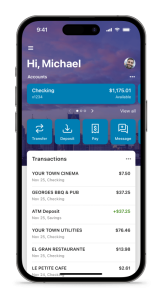
- Set the Stage: Place your check against a dark background to ensure all details are captured clearly due to the contrast.
- Sign and Specify: Endorse the back of the check and write “For Mobile Deposit Only to PDCU” along with your clear signature and account number to streamline processing.
- Open the MyPDCU App: Log in and select "Deposits."
- Enter the Check Details: Enter the check amount and select the account where you want to deposit it.
- Capture the Check Images: Place the front of the check within the phone's frame and tap the screen to capture an image. Repeat for the back of the check.
- Verify the Deposit: Check your transaction history in the app to ensure the deposit was successful.
- Secure Disposal: After confirming the deposit, cut up the check to secure your personal information. Dispose of the pieces separately.
Most members pay nothing for monthly statements by selecting digital delivery to get eStatements at no cost. We charge $5 per month for paper statements mailed to your home. Members under 23 years old receive paper statements free.
5 Helpful Hints About Monthly Statements
- Switch to eStatements today to avoid the $5 monthly paper fee.
- Check your current preference in the MyPDCU app or website.
- Make sure your email address is up to date in your profile.
- Download and save each statement for your records.
- Contact us at 248-263-4100 if you want paper statements or have questions.
We are very grateful for the service that was provided!
April - member since 1989
Disclosures
Learn more about PDCU membership

National Credit Union Day
National Credit Union Day, Celebrated on the third Thursday of October each year, is a special...Read More

Member Appreciation Week 2026
At People Driven Credit Union, our members are at the heart of everything we do. Member Appreciation Week...Read More

Columbus Day Closure: Use the Day to Explore and Learn
[ca-sidebar id="9906"] Every year, on the second Monday of October, many Americans enjoy a long...Read More

How to Tell If Someone Is Using Your Identity
Identity theft does not always announce itself with one obvious warning. Sometimes the first sign is a small...Read More