RV loan rates are not necessarily the same for every borrower or recreational vehicle. Your available rate may depend on your application, requested loan, and the RV you want to finance.

Lenders may consider your creditworthiness, loan amount, loan term, down payment, and the RV’s age, value, and condition. The relationship between the loan amount and the RV’s value can also influence the financing decision.
Understanding these factors can help you prepare before shopping for a motorhome, travel trailer, fifth wheel, or camper.
View current PDCU RV loan rates and available term ranges. Rates are subject to change, and the rate available to you may differ from the lowest advertised rate.
What Is an RV Loan Rate?
An RV loan rate represents the cost of borrowing money to purchase or refinance a recreational vehicle. It affects the amount of interest included in your monthly payment and the total interest paid over the loan term.
A lower rate generally reduces borrowing costs when the loan amount and term remain the same. However, the rate is only one part of the financing decision.
You should also compare:
- The RV’s purchase price
- The amount financed
- The required down payment
- The loan term
- The estimated monthly payment
- The total interest paid
- The RV’s expected ownership costs
A low rate does not automatically make an expensive RV affordable. Review the complete loan and your full ownership budget.
1. Your Creditworthiness
Creditworthiness describes how a lender evaluates your ability and likelihood to repay a loan. Your credit history and credit score may be part of that review, but lenders may also consider other application information.
Factors may include:
- Payment history
- Amounts currently owed
- Length of credit history
- Recent applications for financing
- Income
- Employment information
- Housing expenses
- Existing monthly obligations
A higher credit score does not guarantee a specific RV loan rate. Likewise, one score does not tell you everything about the rate or terms that may be available.
Review your credit reports before applying. If you find incorrect information, follow the credit bureau’s process to dispute it. Correcting an error can take time, so start before you plan to purchase an RV.
2. The RV Loan Amount
The amount you borrow can affect your available rate and terms. A lender reviews whether the requested loan is appropriate for your finances and the RV being used as collateral.
Your loan amount may include:
- The negotiated purchase price
- Approved accessories or optional products included in the purchase
- Remaining negative equity from a trade-in
- Less your down payment
- Less positive trade-in equity
- Less any verified rebate
Borrowing less may reduce your monthly payment and total interest. However, a smaller loan amount does not guarantee a lower rate. Lenders evaluate the complete application and loan structure.
3. The RV Loan Term
The loan term is the amount of time you have to repay the loan. RV loans may have longer terms than many auto loans because some motorhomes and trailers have higher purchase prices.
Different terms may qualify for different rates. A longer term can lower the required monthly payment, but it generally increases the total interest paid.
When comparing terms, ask:
- What rate is available for each term?
- What will the monthly payment be?
- How much interest will I pay over the full loan?
- How long do I expect to own the RV?
- Could I owe more than the RV is worth for an extended period?
Do not select a term based only on the lowest payment. A shorter term may cost more each month but reduce the overall borrowing cost.
4. The RV’s Age
The age of the recreational vehicle can affect available RV loan rates and terms. Older RVs may qualify for different pricing because age can affect value, condition, expected useful life, and resale demand.
This applies to:
- Class A motorhomes
- Class B motorhomes
- Class C motorhomes
- Travel trailers
- Fifth wheels
- Pop-up campers
People Driven Credit Union publishes additional rate information for older collateral on its current RV loan rate table. Review the live page because available rates and requirements can change.
5. The RV’s Collateral Value and Condition
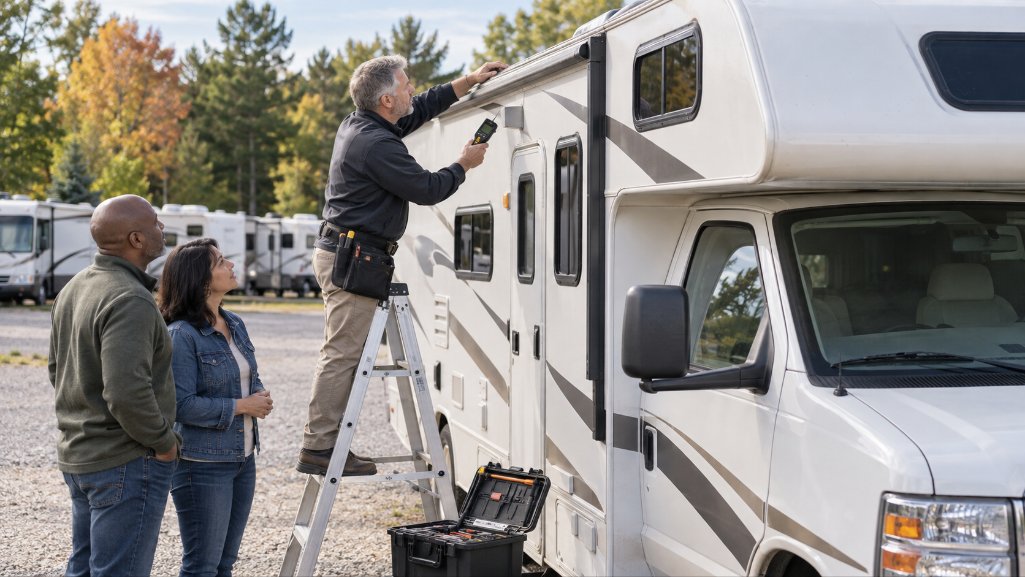
The RV usually serves as collateral for the loan. That means the lender has a financial interest in its value and condition.
The purchase price and collateral value are not always the same. A seller can ask more than the RV’s estimated market value. Optional accessories and dealership products may also increase the purchase amount without adding the same amount to the collateral value.
A lender may consider:
- RV type
- Year, make, and model
- Mileage for a motorhome
- Overall condition
- Market value
- Maintenance history
- Previous damage
- Title status
An independent inspection can help you understand the condition of a used RV before buying. The inspection may identify roof damage, water intrusion, tire wear, appliance problems, electrical issues, or mechanical repairs that affect your budget.
6. The Loan-to-Value Ratio
The loan-to-value ratio, commonly called LTV, compares the loan amount with the RV’s value.
For example, assume an RV is valued at $80,000 and the requested loan is $72,000. Dividing $72,000 by $80,000 produces an LTV of 90%.
A higher LTV means you are borrowing a larger percentage of the RV’s value. A lower LTV means you are borrowing a smaller percentage.
LTV can be affected by:
- The RV’s purchase price
- The lender’s estimated collateral value
- Your down payment
- Positive or negative trade-in equity
- Accessories or optional products added to the financing
If the purchase price is higher than the RV’s value, the lender may limit the amount financed or require a larger down payment. Available requirements depend on the application and loan structure.
7. Your Down Payment
A down payment reduces the amount you need to borrow. It may also reduce the loan-to-value ratio.
A larger down payment can:
- Reduce the amount financed
- Lower the estimated monthly payment
- Reduce total interest paid
- Create more equity at the beginning of the loan
- Help offset a difference between the purchase price and collateral value
A larger down payment does not guarantee a particular rate. The lender will still review your creditworthiness, loan term, requested amount, and the RV.
Keep enough savings available for insurance, registration, storage, maintenance, and unexpected repairs. Using every available dollar for the down payment can leave you unprepared for ownership costs.
8. Automatic Payments

Some lenders offer a rate discount when eligible borrowers set up automatic loan payments. Requirements can vary by lender and account type.
People Driven Credit Union may provide a rate discount for eligible RV loans when automatic payments are made from a PDCU checking or savings account. The advertised lowest rate may already include this discount.
Review the current PDCU RV loan rates and automatic-payment details to confirm the available discount and requirements.
Before enrolling, make sure the selected account will have enough money available when each payment is scheduled.
Other Factors That May Affect RV Financing
The eight factors above are important, but the lender may need to consider other details about the application or purchase.
Additional factors may include:
- Whether the RV is new or used
- Whether you are purchasing or refinancing
- Whether you are buying from a dealer or private seller
- The RV’s title and lien status
- Your trade-in value and remaining balance
- Required insurance documentation
- The completeness and accuracy of your application
Two RVs with the same price may qualify for different terms if their ages, values, conditions, or title histories differ.
How RV Loan Rates Affect Your Payment
The interest rate, loan amount, and term work together to determine the estimated monthly payment.
Use the PDCU RV loan calculator to compare different scenarios. Try changing one field at a time so you can see its effect.
For example:
- Keep the loan amount and term the same, then compare two interest rates.
- Keep the rate and term the same, then increase the down payment.
- Keep the loan amount and rate the same, then compare two loan terms.
- Reduce the purchase price and compare the new payment and total interest.
Calculator results are estimates and do not guarantee approval, loan terms, or a payment amount.
How to Prepare Before Applying
You cannot control every part of the lending decision, but you can prepare accurate information and shop within a clear budget.
- Review your credit reports for errors.
- Estimate a comfortable monthly payment.
- Determine how much you can use as a down payment.
- Check the value and payoff amount of any trade-in.
- Compare new and used RVs.
- Research the market value of the RV you want.
- Arrange an inspection for a used RV.
- Compare more than one loan term.
- Ask whether automatic payments affect the available rate.
- Request RV loan pre-approval before serious negotiations.
Pre-approval can provide a potential financing range before you visit a dealership or contact a private seller. It does not guarantee final approval or a particular rate.
Compare More Than the Advertised Rate
An advertised lowest rate can help you begin comparing lenders, but it may include qualifications that do not apply to every borrower or loan.
When reviewing an offer, compare:
- The rate available to you
- The loan amount
- The required down payment
- The loan term
- The monthly payment
- The total interest
- The amount of any trade-in equity added to or subtracted from the loan
- Whether automatic payments are required for a discount
Ask questions before signing. A lender or dealership should be able to explain how the payment and amount financed were calculated.
Explore RV Loan Rates From People Driven Credit Union
People Driven Credit Union offers financing for eligible new and used motorhomes, fifth wheels, travel trailers, and pop-up campers.
The rate and term available to you may depend on your creditworthiness, requested loan amount, loan term, and the RV’s type, age, value, and condition.
Review Current PDCU RV Loan Rates
Compare current rate and term information for eligible RVs, motorhomes, fifth wheels, travel trailers, and campers. Then use the payment calculator or request pre-approval before you shop.
RV Loan Rates FAQs
RV loan rates may depend on your creditworthiness, loan amount, loan term, down payment, loan-to-value ratio, and the RV’s age, value, type, and condition.
Yes. Older RVs may qualify for different rates or terms because age can affect the vehicle’s value, condition, expected useful life, and resale demand.
Loan-to-value compares the requested loan amount with the RV’s estimated value. Borrowing a larger percentage of the value produces a higher loan-to-value ratio.
A down payment reduces the amount financed and may lower the loan-to-value ratio. It does not guarantee a lower rate because the lender considers the complete application and loan structure.
Available rates may vary by loan term. A longer term can reduce the monthly payment but generally increases the total interest paid over the life of the loan.
Not necessarily. The purchase price is what the buyer agrees to pay. Collateral value is the lender’s assessment of the RV’s market value based on factors such as its type, age, mileage, and condition.
Some lenders offer rate discounts for eligible loans with automatic payments. Review the lender’s current rate information to confirm the discount, qualifying account, and other requirements.
No. Pre-approval does not guarantee final approval or a particular rate. The lender may need to review the selected RV and complete the application process before confirming the final terms.

John Scharff is the Digital Marketing Lead at People Driven Credit Union, where he helps create clear, practical financial content for members and the communities PDCU serves. He focuses on making financial topics easier to understand, from loans and savings accounts to digital banking, fraud prevention, and everyday money management.
View More Posts