A used boat buying checklist helps you compare the boat’s condition, ownership records, and complete cost before you make an offer. The sale price matters, but an overlooked engine problem, damaged trailer, unresolved lien, or large repair can quickly change whether the boat fits your budget.
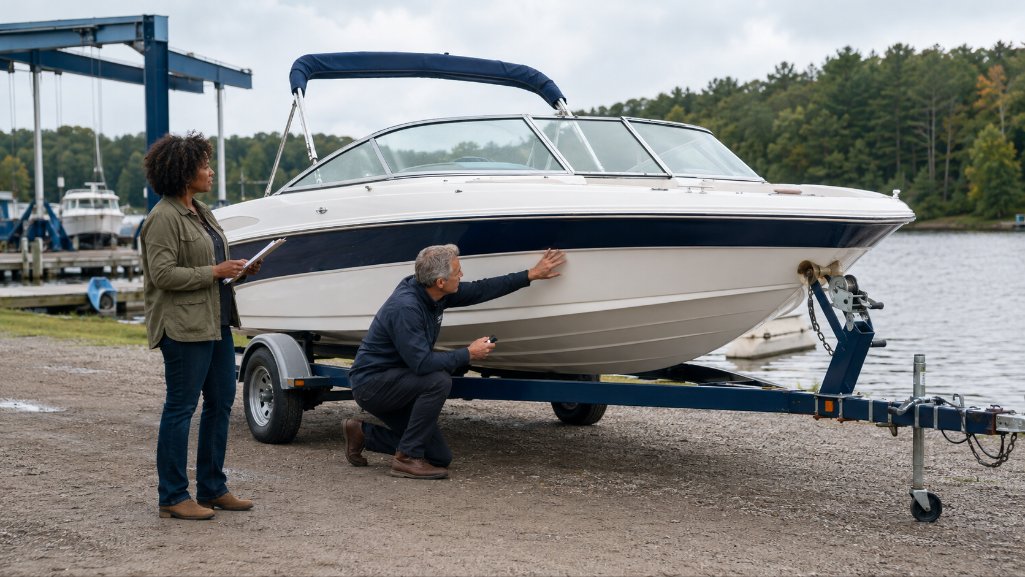
You do not need to know everything about boats to make a careful purchase. You do need enough time to inspect the boat, review its records, confirm ownership, estimate upcoming costs, and arrange financing before the sale becomes final.
1. Define How You Plan to Use the Boat
Start with the type of boating you expect to do most often. A fishing boat, pontoon, bowrider, personal watercraft, and cabin cruiser can have very different purchase prices, operating costs, storage needs, and inspection concerns.
Before shopping, decide:
- How many passengers you expect to carry
- Whether you plan to fish, cruise, tow riders, or stay overnight
- Which Michigan lakes or waterways you expect to use
- Whether you need a trailer
- Where you will store the boat during and after the boating season
- How much time and money you can devote to maintenance
A larger or more powerful boat may offer more room and capability. It can also require a larger tow vehicle, more fuel, more storage space, and more expensive maintenance.
2. Set a Complete Used-Boat Budget
Do not base your budget on the asking price alone. Add the costs required to purchase, prepare, transport, insure, store, maintain, and operate the boat.
Your budget may need to include:
- The negotiated purchase price
- A down payment
- Sales tax, title, and registration expenses
- A marine survey or mechanical inspection
- Immediate repairs and overdue maintenance
- Boat and trailer insurance
- A trailer, tow equipment, or marina transportation
- Dockage, a boat lift, or seasonal storage
- Winterization and spring preparation
- Fuel, safety equipment, electronics, covers, and accessories
Keep part of your budget available for repairs after the purchase. An inspection can reduce surprises, but it cannot predict every future failure.
Use the PDCU boat loan calculator to compare estimated payments using different purchase prices, down payments, interest rates, and loan terms. Look at the total estimated interest as well as the monthly payment.
3. Arrange an Appropriate Marine Survey
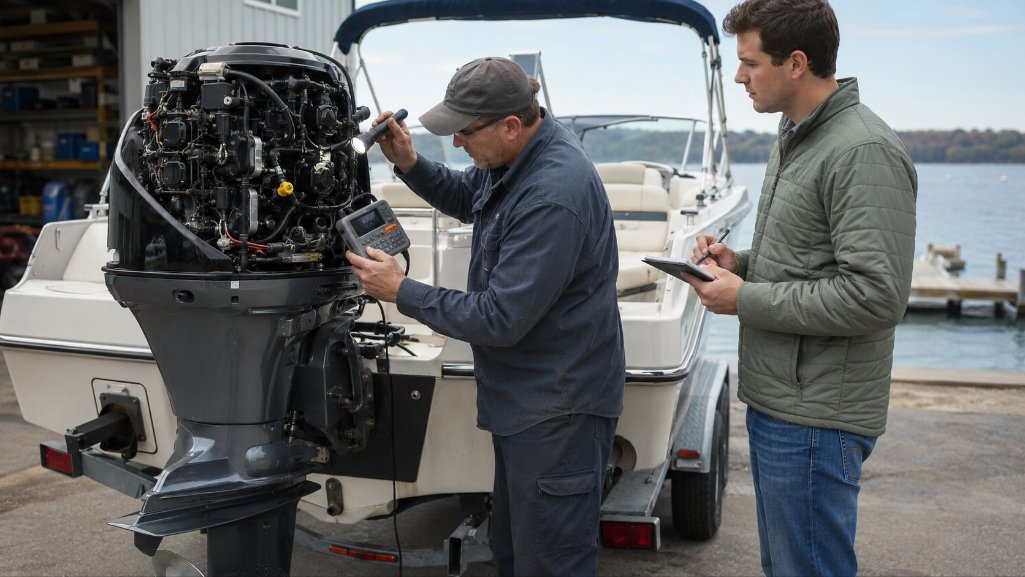
A marine survey is a detailed examination of a boat’s structure, systems, condition, and estimated value. Surveys are common for larger, older, or more valuable boats. The appropriate scope depends on the boat you are considering and may include an out-of-water inspection and an on-water test.
Choose an independent surveyor with experience inspecting that type of boat. Ask what the survey includes before scheduling it. A surveyor may examine the hull, deck, transom, fittings, steering, electrical system, fuel system, plumbing, safety equipment, and signs of moisture or previous damage.
A general marine survey may not include a complete engine diagnosis. Ask whether the engine, outdrive, or transmission needs a separate inspection by a qualified marine technician.
4. Have the Engine and Drive System Inspected
The engine can be one of the most expensive parts of a used boat to repair or replace. A quick start in the seller’s driveway does not provide the same information as a professional inspection and an on-water test under load.
An engine inspection may include:
- Engine hours and diagnostic data, when available
- Compression or leak-down testing when appropriate
- Oil, coolant, filters, belts, hoses, and visible leaks
- Cooling-system operation
- Fuel-system condition
- Starting, idling, shifting, acceleration, and operating temperature
- The propeller, lower unit, outdrive, transmission, and steering
- Signs of corrosion, freeze damage, overheating, or neglected service
Ask the technician to separate urgent safety or reliability problems from routine maintenance and optional improvements. That distinction will help you estimate a realistic post-purchase repair budget.
5. Review the Maintenance Records
Maintenance records can show how consistently the owner cared for the boat. They can also help you determine which services are due soon.
Look for records covering:
- Oil, filter, fluid, spark plug, and impeller changes
- Winterization and spring commissioning
- Battery replacement and electrical repairs
- Fuel-system and cooling-system work
- Lower-unit, outdrive, or transmission service
- Hull, transom, deck, pontoon, or structural repairs
- Trailer tires, bearings, brakes, lights, and suspension work
- Warranty repairs, recalls, or insurance claims
Missing records do not prove that the boat was neglected. They do increase uncertainty. Base your offer and repair reserve on what you can verify, not on a seller’s memory alone.
6. Check the Title, Registration, and HIN
Confirm that the seller has the authority to sell the boat. Compare the seller’s name with the current title or registration. Then compare the hull identification number, or HIN, on the boat with the number shown on the ownership records and purchase agreement.
Michigan generally requires a title for watercraft that are 20 feet or longer and watercraft with a permanently affixed engine, regardless of length. If the boat is not titled, ownership may be transferred using the registration or other records accepted by the Michigan Secretary of State. A federally documented vessel follows a different process.
Review the current Michigan watercraft registration and title requirements before purchasing. If a trailer is included, check its title and registration requirements separately.
Watch for mismatched names or identification numbers, altered HIN plates, missing signatures, crossed-out information, and unexplained gaps in ownership. Resolve any problem before paying the seller or taking possession.
7. Identify and Resolve Any Liens
A lien gives a lender or another secured party a legal interest in the boat. Check the title for a lienholder and ask the seller whether a balance remains.
If the boat has an active lien, obtain current payoff and lien-release information. Do not rely on an informal promise that the seller will pay the loan after receiving your money. Coordinate the transaction with your lender so the existing lien can be addressed and the ownership record can be transferred correctly.
People Driven Credit Union finances eligible boats purchased from private sellers. For a typical private-party purchase, PDCU makes the purchase check payable directly to the seller after the loan, insurance, title, and other documentation requirements are satisfied. An existing lien may require additional coordination.
8. Inspect the Trailer Separately
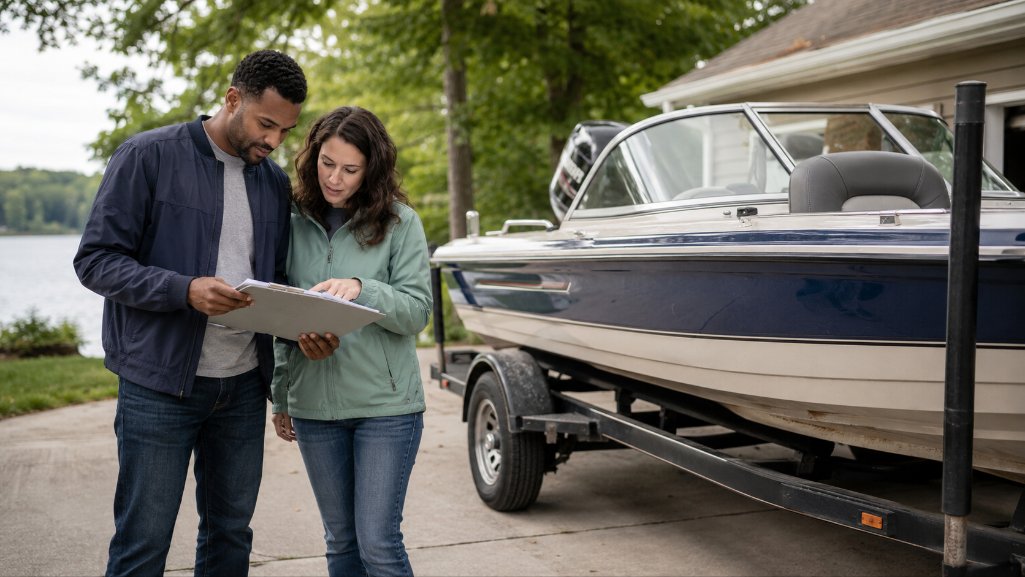
A trailer is its own piece of equipment. A well-maintained boat on a damaged or undersized trailer can still create a large expense and a safety problem.
Check:
- The trailer identification and ownership records
- Frame, crossmembers, welds, bunks, rollers, and winch
- Rust, corrosion, cracks, bending, and previous repairs
- Tire age, tread, pressure, sidewalls, and spare tire
- Wheel bearings, hubs, axles, suspension, and brakes
- Lights, wiring, safety chains, jack, coupler, and breakaway equipment
- The trailer’s weight rating and fit for the boat
Make sure your tow vehicle can handle the combined weight of the boat, motor, trailer, fuel, batteries, and equipment. Confirm whether the trailer is included in the purchase price and list it clearly in the purchase agreement.
9. Turn Inspection Findings Into Repair Estimates
An inspection report is most useful when you convert the findings into estimated costs and timing. Ask a qualified repair facility for estimates on major items before you finalize the purchase.
| Category | What It Means | How to Use It |
|---|---|---|
| Immediate | Affects safe operation, reliability, insurability, or basic function. | Resolve before purchase or include the full repair in your budget and agreement. |
| Near term | Likely needs service or replacement during the next boating season. | Add the estimated cost to your first-year ownership budget. |
| Routine | Normal maintenance associated with the boat’s age and use. | Include it in your annual maintenance plan. |
| Optional | Improves appearance, comfort, electronics, or performance. | Delay it if the purchase would otherwise stretch your budget. |
Use written estimates when negotiating. Decide whether the seller will complete a repair, reduce the price, or sell the boat in its current condition. Put the final agreement in writing.
10. Get an Insurance Quote Before You Buy
Ask for an insurance quote on the specific boat before completing the purchase. The boat’s age, value, size, horsepower, condition, equipment, storage location, and navigation area may affect the available coverage and premium.
Tell the insurer about known damage, modifications, and the survey findings. Ask what the policy covers for the boat, motor, trailer, personal property, liability, towing, and storage. A lender may also have specific insurance requirements.
PDCU requires insurance for a financed boat. Ask your loan specialist what proof of insurance and coverage details are needed before closing.
11. Review the Purchase Agreement
The purchase agreement should describe exactly what you are buying and the conditions that must be met before the sale becomes final.
Include:
- The buyer’s and seller’s names and addresses
- The boat’s year, make, model, length, HIN, and registration number
- Engine information and serial number
- Trailer information when included
- The agreed purchase price and any deposit
- A list of included equipment and accessories
- Known liens and the steps required to release them
- Repairs the seller agrees to complete
- Financing, inspection, survey, or on-water-test conditions
- The closing and possession date
- The signatures and dates of both parties
Do not leave important promises out of the written agreement. A clear agreement protects both parties from different recollections later.
12. Arrange Financing Before the Final Decision
Boat loan pre-approval can help you establish a shopping budget before you compare used boats. It can also help you focus negotiations on the purchase price instead of discussing only the monthly payment.
People Driven Credit Union offers financing for eligible used boats. Your available loan amount, Annual Percentage Rate, and term may depend on your application and the boat’s age, value, and condition. Older boats may have different financing options or require additional review.
Before accepting a loan, compare:
- The purchase price and down payment
- The amount financed
- The APR
- The loan term
- The monthly payment
- The total estimated interest
- The repair reserve left in your budget
Pre-approval does not guarantee financing for a particular boat. Final approval may depend on updated application information and the boat offered as collateral.
Used Boat Buying Checklist
- Define how and where you will use the boat.
- Set a budget that includes ownership and repair costs.
- Arrange an appropriate marine survey.
- Have the engine and drive system inspected.
- Review maintenance and repair records.
- Match the seller, title or registration, and HIN.
- Identify and resolve any liens.
- Inspect and document the trailer separately.
- Obtain estimates for immediate and near-term repairs.
- Get an insurance quote and confirm lender requirements.
- Put the complete purchase agreement in writing.
- Compare financing based on total cost, not only the payment.
Finance an Eligible Used Boat With PDCU
Review current boat loan information, estimate your payment, or apply before you choose a specific boat. After you submit your application, a People Driven Credit Union loan specialist will contact you.
Loan approval is subject to application, creditworthiness, membership eligibility, and collateral considerations. Available loan amounts, rates, and terms may vary based on the boat’s age, value, and condition. Rates are subject to change.
Frequently Asked Questions About Buying a Used Boat
A marine survey can help identify structural, system, safety, and condition concerns before you buy. The need and appropriate scope depend on the boat’s type, size, age, value, and intended use.
Not always. Ask the surveyor what is included. You may need a separate engine and drive-system inspection from a qualified marine technician.
Missing records increase uncertainty about past care and upcoming service. Use the inspection results and repair estimates to decide whether the price and risk still fit your budget.
Review the title for a listed lienholder and ask the seller for payoff or lien-release information. Coordinate an active lien with your lender before paying the seller or taking possession.
Yes. Check the trailer’s ownership records, frame, tires, bearings, axles, brakes, lights, coupler, safety equipment, weight rating, and fit for the boat.
Do not assume repair costs can be added to the loan. Ask PDCU how the boat’s purchase price, value, condition, and requested loan amount will be evaluated before agreeing to repairs or financing.
Yes. PDCU offers financing for eligible used boats. Approval and available terms depend on your application and the boat’s age, value, and condition.
Yes. You can apply for PDCU boat loan pre-approval before choosing a specific watercraft. Final approval still depends on the completed application and the boat offered as collateral.

John Scharff is the Digital Marketing Lead at People Driven Credit Union, where he helps create clear, practical financial content for members and the communities PDCU serves. He focuses on making financial topics easier to understand, from loans and savings accounts to digital banking, fraud prevention, and everyday money management.
View More Posts